
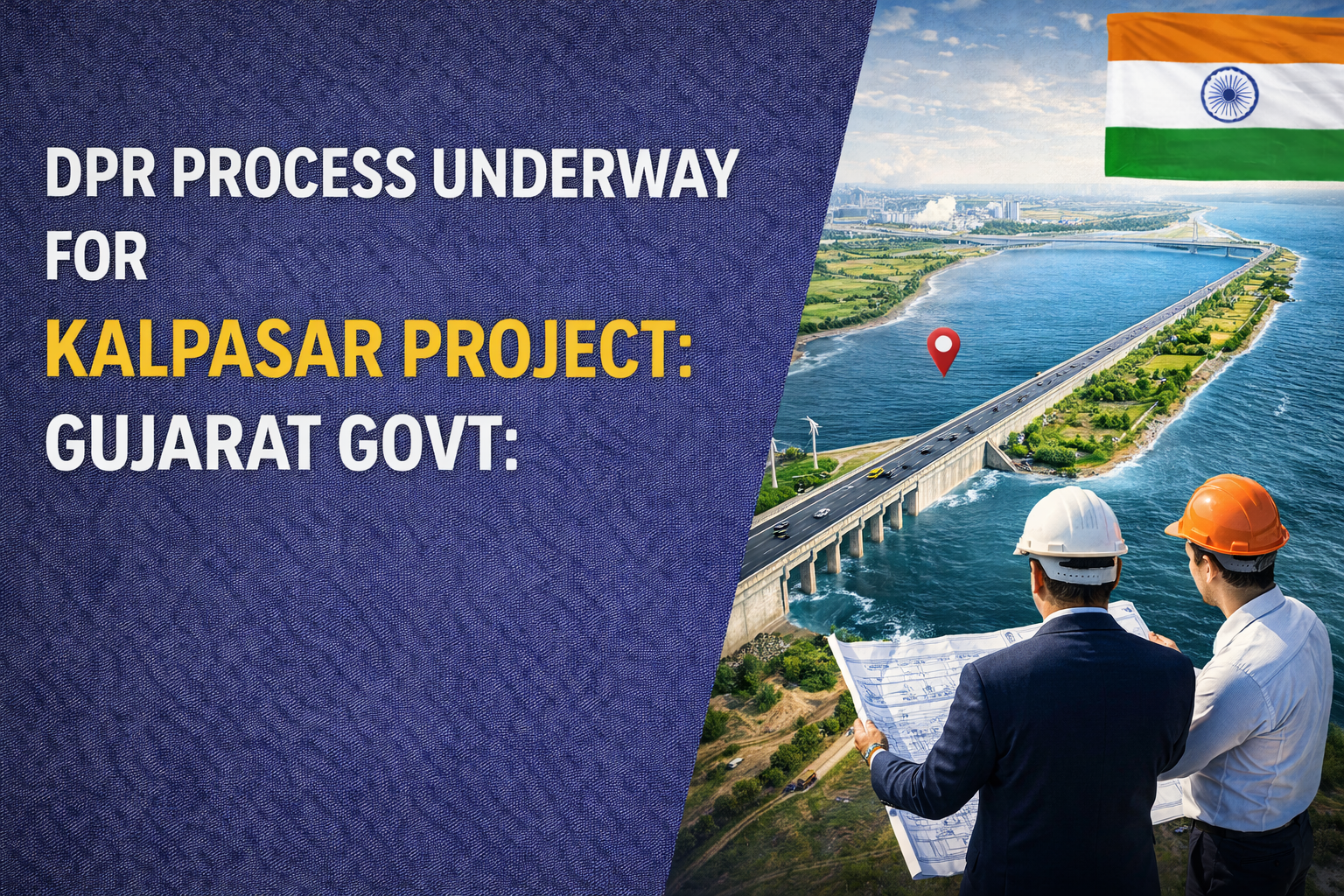
The Government of Gujarat has announced that the Detailed Project Report (DPR) process for the ambitious Kalpasar Project is currently underway, marking a renewed push toward one of India’s most visionary infrastructure initiatives. The Kalpasar Project, long discussed as a transformative water resource and infrastructure development plan, aims to create a massive freshwater reservoir in the Gulf of Khambhat. With the DPR process progressing, the Gujarat government has signaled serious intent to convert this decades-old vision into a practical, implementable project.
What is the Kalpasar Project?
Contents
The Kalpasar Project (Gulf of Khambhat Development Project) is designed to build a dam across the Gulf of Khambhat to store rainwater that would otherwise flow into the Arabian Sea. The stored freshwater would be used for irrigation, drinking water supply, and industrial use across drought-prone regions of Gujarat. Apart from water conservation, the project also envisions improved road connectivity through a dam-top roadway, significantly reducing travel distance between South Gujarat and Saurashtra. With the DPR process underway, technical feasibility, environmental impact, and financial viability are being closely evaluated.
Focus on Technical and Environmental Assessment
The preparation of a Detailed Project Report (DPR) is a crucial step in large-scale infrastructure projects like Kalpasar. The DPR will include hydrological studies, environmental impact assessments, geological surveys, and cost estimations. Given the scale of the Kalpasar Project, the Gujarat government is ensuring that global best practices and modern engineering standards are incorporated. Environmental sustainability is expected to be a key focus, considering the ecological sensitivity of the Gulf of Khambhat region.
Water Security and Irrigation Benefits
Water scarcity remains a major challenge in several parts of Gujarat. The Kalpasar Project has the potential to transform water security in the state by providing a sustainable freshwater reservoir. Once implemented, the project could benefit agriculture through expanded irrigation facilities, supporting farmers and boosting crop productivity. Improved water availability would also strengthen industrial growth corridors, including regions near Dholera and other emerging industrial zones. In this way, the Kalpasar Project aligns with Gujarat’s long-term water management and economic development strategies.
Infrastructure and Economic Growth Opportunities
Beyond water conservation, the Kalpasar Project is expected to create substantial economic opportunities. Infrastructure development on this scale typically generates employment during construction and operational phases. Enhanced connectivity through a proposed roadway over the dam could significantly reduce transportation time and logistics costs. The Gujarat government sees Kalpasar as a multi-dimensional project that combines water resource management, infrastructure development, and regional economic growth.
Government Commitment and Future Outlook
The announcement that the DPR process is underway reflects the Gujarat government’s commitment to reviving and advancing strategic mega projects. While the Kalpasar Project involves complex technical and environmental considerations, the initiation of the DPR stage indicates that planning is moving forward in a structured manner. Experts believe that if executed successfully, Kalpasar could become one of India’s most significant water infrastructure projects.
Conclusion: A Transformational Vision for Gujarat
The DPR process for the Kalpasar Project marks an important milestone in Gujarat’s infrastructure journey. With a strong focus on water security, sustainable development, and regional connectivity, the project has the potential to reshape Gujarat’s economic and environmental landscape. As detailed studies progress, all eyes will remain on how this ambitious vision translates into reality in the coming years.